Nine Dollars to a Bench Warrant: Tracing the Escalation Pipeline of Unpaid Tolls
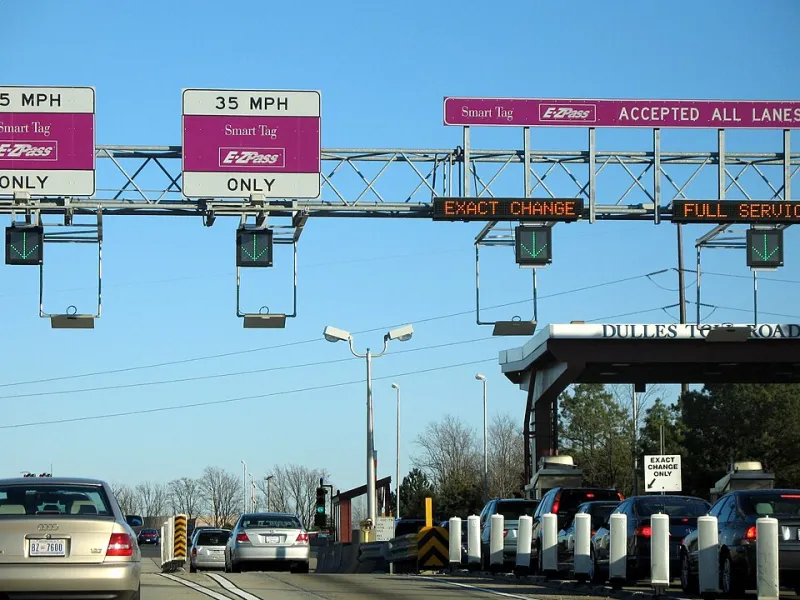
Photo: MPD01605, Public domain, via Wikimedia Commons
From Fare Evasion to Fugitive Status
Most motorists who cross a tolled bridge without paying imagine the consequence as a fine — an inconvenience, perhaps, but a bounded one. The peer-reviewed record suggests otherwise. Across several metropolitan tolling authorities, unpaid tolls enter an administrative cascade in which each missed notice compounds: civil penalties multiply, registration renewals are blocked, referrals are made to courts, and in a measurable share of cases, bench warrants issue. What begins as a nine-dollar toll debt can end with a driver detained during a routine stop in a neighboring state.
This article synthesizes the empirical literature on that pipeline and situates it within the framework this journal applies to mobility governance: the question of whether administrative systems that restrict physical movement satisfy basic standards of notice, proportionality, and due process.
Mapping the Escalation Sequence
The enforcement architecture follows a recognizable sequence. First, the tolling operator issues a violation notice, typically adding a fee that can exceed the original toll several times over. Second, repeated non-payment triggers a hold at the state DMV, preventing registration renewal — a sanction that renders daily driving unlawful without any judicial finding. Third, persistent non-response is referred to a court, where the defendant's absence from a hearing they may never have received notice of produces a bench warrant. Finally, because warrants enter interstate databases, an individual can be arrested far from the original corridor, converting a regional toll dispute into a matter of multi-jurisdictional criminal enforcement.
Studies of violation data in toll-heavy corridors — including the Bay Area's Fastrak system and comparable electronic tolling regimes in the Northeast — consistently find that escalation is not randomly distributed. Collections and referral records show concentration in ZIP codes with the lowest median incomes, along corridors where tolling functions as a de facto tax on the commute for workers with no transit alternative.
The Poverty Trap in Administrative Form
Three features of the pipeline warrant scrutiny from a rights perspective.
Compounding opacity. Notices are mailed to addresses that low-income and highly mobile households change frequently. Research on civil legal process documents high rates of defective service; a driver who never learns of the first violation nonetheless accrues each subsequent penalty.
Proportionality collapse. The literature on fines and fees — including the Supreme Court's jurisprudence on incarcerating indigent defendants for unpaid monetary obligations — has repeatedly cautioned against sanctions that punish poverty as though it were willfulness. Toll escalation inverts that principle administratively: the sanction grows precisely because the motorist cannot pay.
Extraterritorial reach. Unlike most civil debts, a warrant travels. An unpaid account tied to a single bridge crossing can surface during a traffic stop hundreds of miles away, subjecting the individual to arrest, impoundment, and the collateral consequences of a criminal record. Few other consumer debts carry this mobility penalty.
What the Data Support — and What They Cannot Yet Show
Honest analysis requires acknowledging evidentiary limits. No national dataset systematically links toll violations to warrant issuance; the strongest studies are regional, drawing on operator records and court dockets. Estimates of the share of warrants originating in toll cases vary widely by jurisdiction, and some authorities have reformed their practices — decriminalizing violations, capping fees, or offering amnesty programs — precisely because the escalation model proved both costly and regressive.
Yet the direction of the evidence is consistent. Wherever researchers have obtained referral-level data, the population swept into the enforcement pipeline skews toward households least able to absorb compounding penalties and most dependent on the tolled corridor for employment access.
Policy Implications
The findings point toward several reforms consistent with a mobility-rights framework:
- Decriminalization of toll non-payment, reserving warrants for fraud rather than debt.
- Ability-to-pay screening before any referral to collections or courts, mirroring standards applied to other government debts.
- Registration hold reform, since blocking vehicle registration punishes driving itself and accelerates the spiral of unlicensed operation.
- Interstate data hygiene, ensuring that administrative violations do not generate arrestable warrants across state lines without judicial review.
Conclusion
The unpaid toll is a trivial debt wearing the machinery of serious criminal enforcement. The empirical record indicates that this machinery operates with minimal notice, no proportionality review, and consequences that follow individuals across jurisdictions. For scholars of mobility governance, toll escalation offers a compact case study of how routine administrative systems can quietly produce the same restriction on physical liberty that constitutional doctrine reserves for the state's most deliberate exercises of power. A system that converts nine dollars of bridge crossings into a fugitive warrant is not merely inefficient; it is a rights problem hiding in plain sight on the morning commute.