Seconds of Belonging: What Pedestrian Signal Timing Reveals About Whose Movement Cities Prioritize
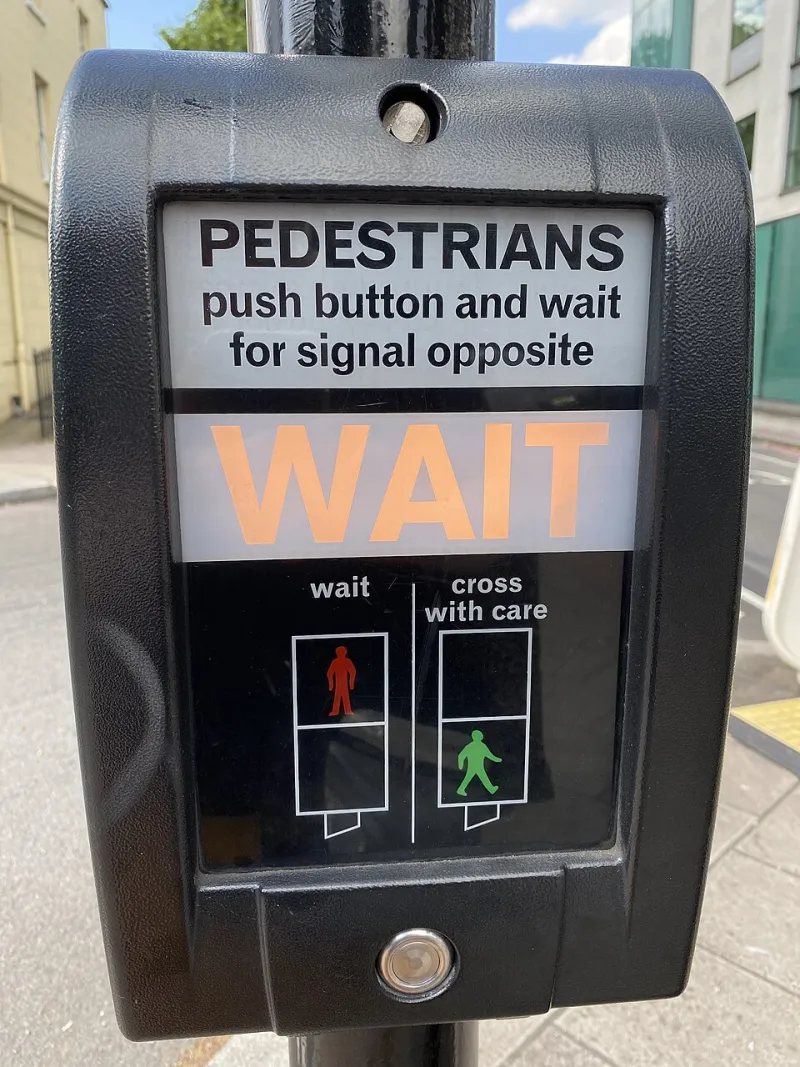
Photo: Secretlondon, CC BY-SA 4.0, via Wikimedia Commons
The Four-Foot-Per-Second Assumption
Beneath nearly every traffic signal in the United States lies a single, quiet assumption: that the pedestrian crossing the street walks at approximately 3.5 feet per second. That figure, codified in successive editions of the Manual on Uniform Traffic Control Devices (MUTCD), has historically governed how long a walk interval lasts. The problem, documented repeatedly in peer-reviewed transport literature, is that a substantial share of the population does not move at that pace — and never will.
Research on gait speed has shown that many adults over 65, individuals using mobility aids, and young children walk considerably slower than the design standard. In practical terms, a signal timed for the average able-bodied adult converts a routine crossing into a timed examination that some pedestrians are structurally destined to fail. At a busy arterial intersection in Phoenix or Detroit, the difference between a compliant crossing and a stranded one can be a matter of two or three seconds — a duration invisible to traffic engineers but consequential for the person caught mid-crosswalk when the light changes.
Measuring the Gap Between Design and Demographics
A growing body of empirical work has treated pedestrian signal timing not as a fixed technical parameter but as a variable worth auditing. Studies comparing observed crossing speeds against programmed intervals have found that in some urban corridors, a meaningful fraction of older pedestrians required more time than the signal provided, with many compensating by beginning to cross late, hurrying unsafely, or waiting through multiple cycles for a gap in traffic.
The methodological significance of this work lies in its reframing. Signal timing, the literature suggests, functions as a distributional record. Every intersection embodies a decision — explicit or inherited — about whose travel time matters. When a city times its signals for a 3.5-foot-per-second pedestrian, it effectively allocates the intersection to a particular kind of body: young enough, fast enough, unassisted. Everyone else is accommodated, if at all, through exception.
The Federal Response and Its Limits
Policy has begun to move. The 2023 update to the MUTCD lowered the default presumed walking speed to 3.2 feet per second and encouraged agencies to set even slower speeds — down to 2.5 feet per second — at locations with high volumes of older adults or people with disabilities. Separately, the Accessible Streets guidance issued by the Federal Highway Administration in late 2023 directed states receiving federal highway funds to adopt policies extending crossing times.
Yet implementation remains uneven. Audits of municipal signal programs reveal wide variation in how quickly agencies have reprogrammed existing signals, and slower walk intervals are frequently confined to neighborhoods already identified as senior-heavy or disability-dense. The result is a patchwork in which the same person may find an accessible crossing in one district and a hostile one a mile away — a spatial inequity that maps closely onto existing patterns of age segregation, disability, and disinvestment.
Timing as a Rights Question
It is tempting to file signal timing under technical standards — a matter for traffic operations manuals rather than rights discourse. The peer-reviewed literature increasingly resists that framing. If mobility is a precondition for participating in civic, economic, and social life, then infrastructure that systematically slows or excludes particular groups raises questions of equal access that parallel those long applied to transit and housing.
The analytic advantage of signal timing is its measurability. Unlike diffuse forms of exclusion, a walk interval can be timed, compared against demographic gait data, and scored. A city's crossings can be audited street by street, producing a distribution of access that is difficult to dispute. Advocacy organizations have already begun using such audits to press for retiming programs, and several jurisdictions — including New York City, which lowered its standard walking speed citywide — have demonstrated that correction is administratively feasible.
A Correctable Injustice
The most important finding in this literature may be its optimism. Unlike entrenched forms of mobility restriction that require legislative action or constitutional litigation, signal timing is corrected with firmware. The cost of adding four seconds to a walk interval is negligible next to the safety and autonomy gains it produces: fewer stranded pedestrians, fewer falls, fewer risk-taking crossings, and a network that older residents and disabled pedestrians can navigate with confidence.
For scholars and policymakers, the crosswalk offers a rare case study in which a measurable design parameter aligns directly with a distributional question: whose movement does this city value, and by how many seconds? The research suggests that until the answer includes those who walk slowly, the urban street remains an infrastructure of quiet sorting — one that can, and increasingly should, be retimed.