No Ride, No Defense: When Rural Courts Demand Attendance the Highway Cannot Deliver
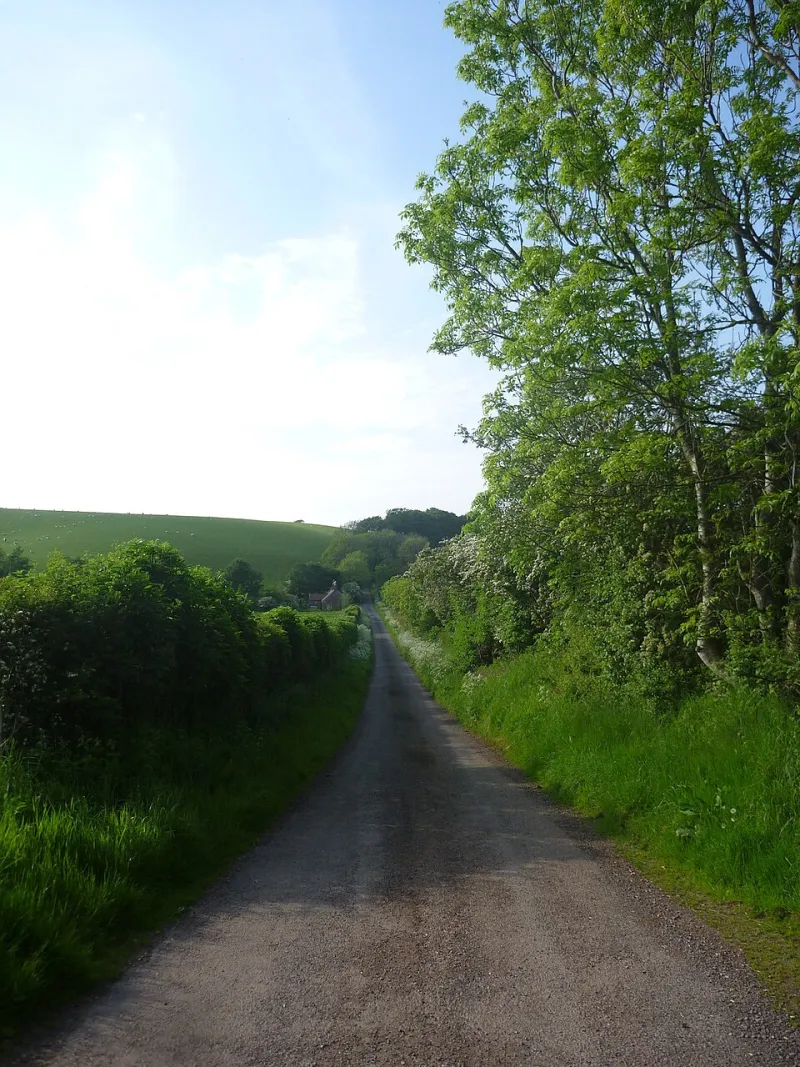
Photo: Richard West , CC BY-SA 2.0, via Wikimedia Commons
The Appearance Requirement Meets the Empty Roadside
American criminal procedure rests on a deceptively simple premise: the defendant appears. Statutes across the states make appearance mandatory, and failure to appear converts a misdemeanor into a felony in many jurisdictions. Yet a growing body of peer-reviewed scholarship documents a structural contradiction at the heart of this requirement. In counties without public transportation, the state compels a journey it has made physically impossible for a substantial share of its residents.
The contradiction is most acute in the roughly 1,300 nonmetropolitan counties where fixed-route transit simply does not exist. A defendant in a rural county may live thirty or forty miles from the courthouse, with no licensed driver in the household, no family vehicle, and no bus. The summons arrives by mail; the means of compliance does not arrive at all.
What the Research Shows
Several recent empirical studies, examined collectively, trace a consistent pattern. In counties lacking transit service, failure-to-appear rates run measurably higher than in comparable counties with even minimal demand-response service. The relationship holds after controlling for offense severity, age, and prior record — suggesting that geography, not character, explains much of the gap.
The downstream consequences compound quickly. A missed appearance triggers a bench warrant. The warrant leads to arrest, often during a traffic stop for an unrelated infraction. Booking fees, warrant fees, and additional court costs attach to the original debt. Scholars of legal financial obligations have documented how a $150 fine can swell into a four-figure judgment through precisely this pipeline — and transportation absence is one of its most reliable ignition points.
A subset of this literature frames the problem in explicitly constitutional terms. If the state's monopoly on coercion obligates a person to appear, and the same state has withdrawn the infrastructure that makes appearance feasible, the procedural guarantee of one's day in court becomes contingent on car ownership. Due process, on this reading, should not vary with the distance to the nearest bus stop.
The Bench Warrant as a Mobility Event
It is tempting to classify warrant issuance as a failure of individual responsibility. The data complicate that framing. Qualitative studies of rural court users repeatedly record the same account: defendants who wanted to appear, who called the clerk's office, who asked relatives for rides, and who simply had no way to cover a forty-mile round trip on a weekday.
Courts rarely ask why a defendant did not appear before issuing the warrant. The administrative record treats absence as volition. But when researchers matched court records against transit maps, they found that failure-to-appear rates clustered along the boundaries of transit service areas with striking regularity. The warrant, in effect, maps onto the highway more accurately than it maps onto the docket.
Counties That Built the Remedy
A handful of jurisdictions have treated this as an infrastructure problem rather than a discipline problem, and their experiments deserve systematic review.
Several rural counties in the Midwest and Pacific Northwest now operate court-day shuttles — scheduled vans that circulate between outlying townships and the county seat on docket days, coordinated with clerk's offices so that ride schedules align with arraignment calendars. Early administrative evaluations report meaningful declines in warrant issuance in participating counties, alongside reduced jail bed days spent on failure-to-appear bookings.
Other jurisdictions have adopted remote appearance authority more aggressively, expanding video arraignment for non-evidentiary hearings. Here the evidence is more mixed. Teleappearance removes the transportation barrier but introduces a connectivity barrier of its own in broadband-poor counties, and some defense advocates caution that virtual proceedings dilute the communicative dimension of appearing before a judge.
A third model treats the problem upstream: some public defender offices now include a transportation screening question at arraignment, allowing a documented transit barrier to be entered into the record before a warrant can issue.
A Policy Agenda Grounded in the Evidence
The research base, while still maturing, supports several defensible recommendations for state policymakers:
- Mandate a transit inquiry. Courts should be required to ask, on the record, whether an appearance obligation is feasible given the defendant's location and mobility resources.
- Fund court-day transit as a justice expenditure. Shuttle programs in pilot counties cost a fraction of warrant execution and jail housing, suggesting a favorable fiscal arithmetic for state grants.
- Standardize failure-to-appear data. Counties should record the reason for non-appearance, enabling rigorous evaluation rather than anecdote.
- Pair remote options with connectivity investment, so that virtual appearance is a genuine alternative rather than a transfer of the same barrier.
Geography Is Not a Defense Strategy
The constitutional promise of a fair trial presumes that the accused can physically reach the courtroom. In rural America, that presumption is often false, and the peer-reviewed record now demonstrates the consequences in warrants, debts, and jail populations. The state that commands attendance has an obligation to reckon with the distance it has imposed. The counties that built shuttles did not invent a new right; they simply stopped making the existing one impossible to exercise.